


- Broom-finished concrete
- Exposed aggregate concrete
- Stamped concrete
- Brick driveways
- Concrete and clay pavers
- Driveway aprons and adjoining walks
Why do driveways get so dirty?
Concrete and masonry are porous, so they absorb oil, dirt, tannins and moisture rather than simply holding them on top. Add vehicle traffic, shade and runoff from the yard, and a driveway darkens steadily from the day it is poured.
A driveway takes more abuse than any other surface around a home. Tires carry in road grime and track it along the same lines every day. Cars drip oil, coolant and brake fluid in the same spot. Trees drop leaves, seeds and pollen, and runoff from lawns and beds carries soil across the slab. In shaded sections, that moisture and organic debris feeds algae and moss.
- Dark tire tracks and turning marks near the garage.
- Oil spots where vehicles park.
- Green or black patches along shaded edges and under trees.
- Orange-brown staining from red clay, fertilizer or rust.
- An overall gray film that hides the concrete’s original color.
Can oil stains and tire marks be removed from a driveway?
Tire marks usually come out well. Oil stains can usually be lightened significantly, but older stains that have soaked deep into the concrete may leave a faint shadow. Ultimate Powerwash will tell you honestly what to expect before we start.
Oil and fluid stains
Oil soaks into the pores of concrete. A fresh drip sits near the surface and responds well to a degreaser, some dwell time and hot water. A stain that has been baking in for years has wicked much deeper, beyond the reach of any surface cleaning. We can often reduce it a great deal, but a shadow may remain, and more aggressive attempts risk damaging the concrete around it.
Tire marks
Everyday tire marks are rubber and road grime on the surface, and a pre-treatment plus even surface cleaning typically removes them. On sealed or coated driveways, a different problem called hot tire pickup can occur, where warm tires lift or discolor the sealer itself. That is a coating issue, and cleaning alone won’t repair it.
What causes green, brown and rust-colored stains on a driveway?
Green and black patches are usually algae, moss or mildew-type organic growth in shaded areas. Brown leaf silhouettes are tannin stains, and orange spots are often rust from fertilizer granules, iron-rich water or metal objects.
- Algae and moss
- Common along shaded edges, beside lawns and where water pools. They also make the surface slick when wet.
- Leaf and tannin stains
- Brown outlines left by wet leaves, acorns and seed pods. They usually respond to a cleaning solution and time.
- Rust
- Often caused by iron-containing fertilizer granules, sprinkler water with iron in it, or metal furniture and tools. Rust generally needs a specialty rust remover; pressure alone rarely lifts it.
- Red clay
- Washed onto driveways from beds and construction areas. Iron-rich clay can stain more stubbornly than ordinary dirt.
Why use a surface cleaner instead of a pressure wand on a driveway?
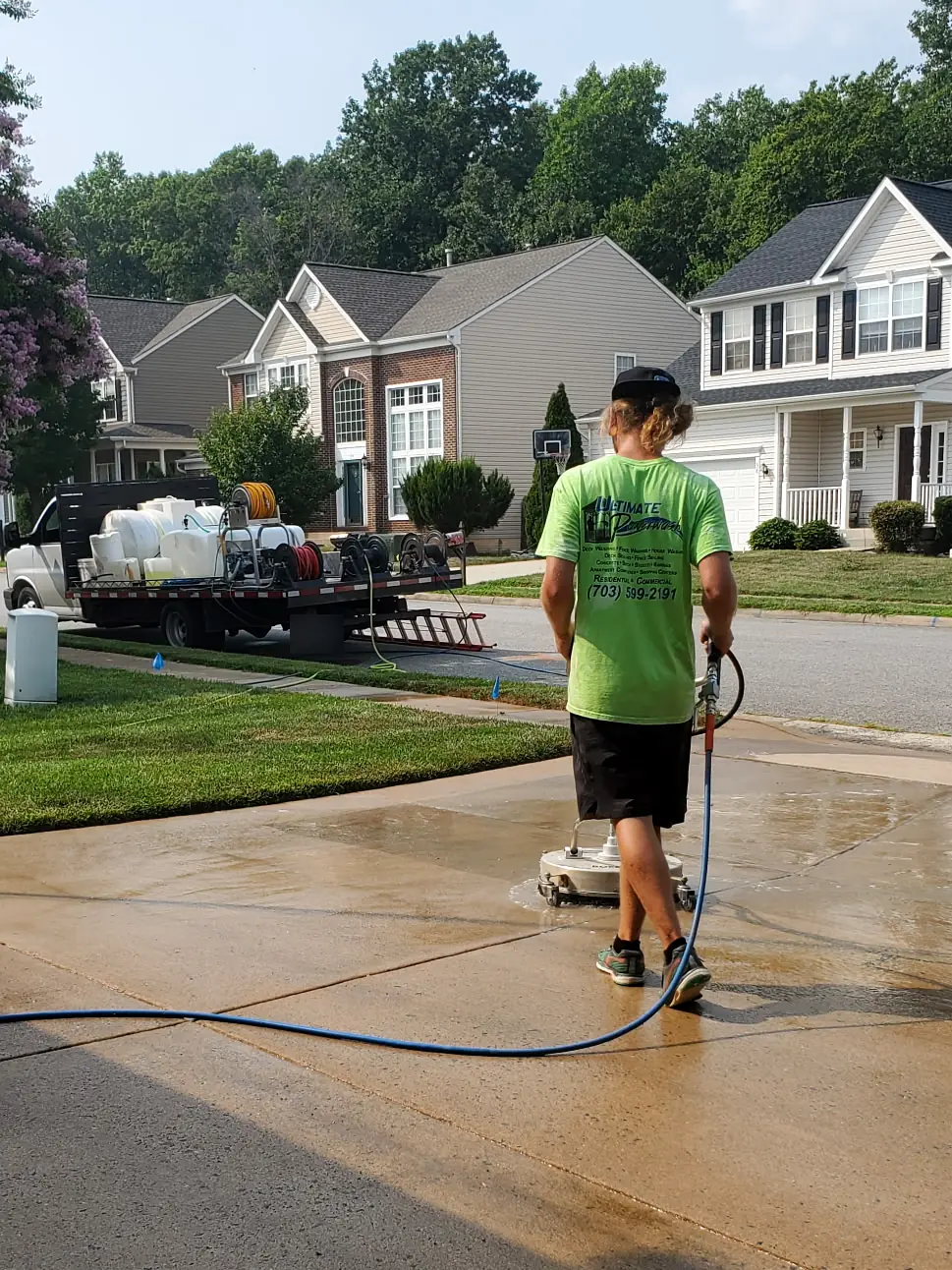
A surface cleaner holds its spinning nozzles at a fixed height and spreads the cleaning evenly, so the driveway comes out uniform. A handheld wand swept back and forth tends to leave light and dark stripes and can etch the concrete.
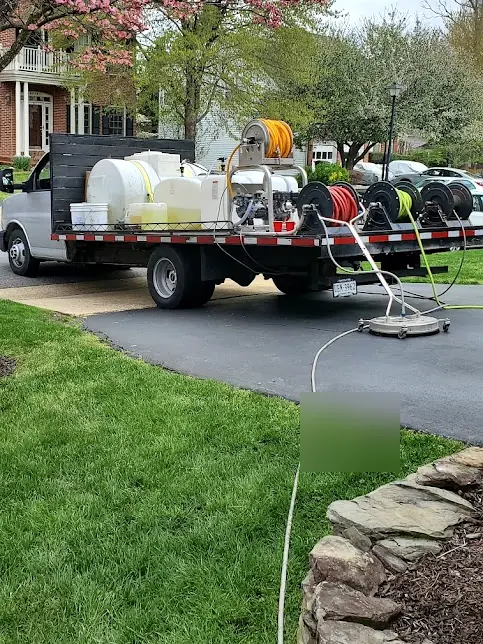
A surface cleaner is a round, hooded tool with a rotating bar underneath. As it moves across the slab, the nozzles stay the same distance from the concrete the whole time. The result is consistent cleaning with no wand striping, less overspray onto cars and siding, and far less risk of carving lines into the surface.
The wand still has a place: along edges, expansion joints, steps and the curb line, where a round cleaner can’t reach. Used with a wider tip at a sensible distance, it details those areas without harming them. This is the same technique we use on flatwork across our pressure washing service.
What are pre-treatment and post-treatment in driveway cleaning?
Pre-treatment means applying a cleaning solution or degreaser before pressure washing so stains loosen first. Post-treatment is a solution applied after cleaning to treat remaining organic growth and help the surface stay clean longer.
- Pre-treatment
- Degreaser on oil spots, a cleaning solution on algae and organic staining, and time for both to work. It lets the surface cleaner do its job with less effort.
- Surface cleaning
- The even, overlapping passes that lift the loosened grime and dirt from the whole slab.
- Post-treatment
- A solution applied to the cleaned surface to treat organic growth that survived and to reduce streaking as the concrete dries, followed by a rinse where needed.
Skipping these steps is one reason a driveway can look clean while wet and blotchy once dry. For a broader look at the methods involved, see our guide on how to clean concrete.
How are brick and paver driveways cleaned differently?
Brick and paver driveways are cleaned with more restraint than poured concrete, because high pressure can wash out joint sand and wear the faces of softer units. The goal is to clean the pavers without destabilizing the joints.
Pavers rely on the sand between them to lock the surface together and keep weeds down. Aggressive cleaning pulls that sand out, loosening the units over time. Brick, especially older clay brick, can be softer than it looks. Both also tend to show efflorescence, a white, powdery salt deposit that behaves differently from ordinary dirt. We explain it in detail on our concrete, brick and stucco cleaning page.
Should you seal your driveway after it is cleaned?
Sealing is optional, but many homeowners seal concrete or pavers to reduce staining and water absorption. If you plan to seal, a thorough cleaning comes first, and the surface must be completely dry before any sealer is applied.
Sealers fall into two broad groups. Penetrating sealers soak into the concrete and repel water without changing its look much. Film-forming sealers sit on top, often adding a sheen or darker “wet look”, but they can become slippery and are more prone to hot tire pickup. Whichever type you choose, sealing over dirt, algae or oil locks the stain in, so cleaning is the first step whether you seal it yourself or hire a sealing contractor.
How do Virginia winters affect a concrete driveway?
Freeze-thaw cycles are hard on concrete. Water in the pores expands as it freezes, and over many winters that can cause surface scaling and flaking, especially where de-icing salts are used.
Winters in Stafford and Fredericksburg bring regular swings above and below freezing. Each cycle puts a little stress on the top layer of a driveway, and de-icing salts add to it. Cleaning doesn’t repair scaling, but removing grime, salt residue and organic growth helps the slab dry out faster and lets you see problem areas early. We avoid cleaning driveways when a hard freeze is expected, since rinse water can turn to ice.
Ultimate Powerwash is based in Stafford County. See our work in Stafford and Fredericksburg, or request a free driveway cleaning quote. Our work is satisfaction guaranteed.
How our driveway cleaning process works
Identify the stains
We look at the surface type and condition and sort stains into those that should come out and those that may only lighten.
Clear and protect
Vehicles and items are moved off the driveway, and nearby siding, garage doors and plantings are protected from overspray.
Pre-treat
Degreaser goes on oil spots and a cleaning solution on organic staining, with time to work.
Surface clean and detail
A surface cleaner covers the slab evenly, and edges, joints and the curb line are detailed by hand.
Post-treat and rinse
Remaining growth is treated where needed, and debris is rinsed off the driveway and away from beds.
What driveway cleaning removes
- Oil and vehicle fluid drips
- Tire marks
- Algae, moss and organic staining
- Rust stains
- Leaf and tannin stains
- Red clay and mud
- Ground-in dirt